
It happened again.
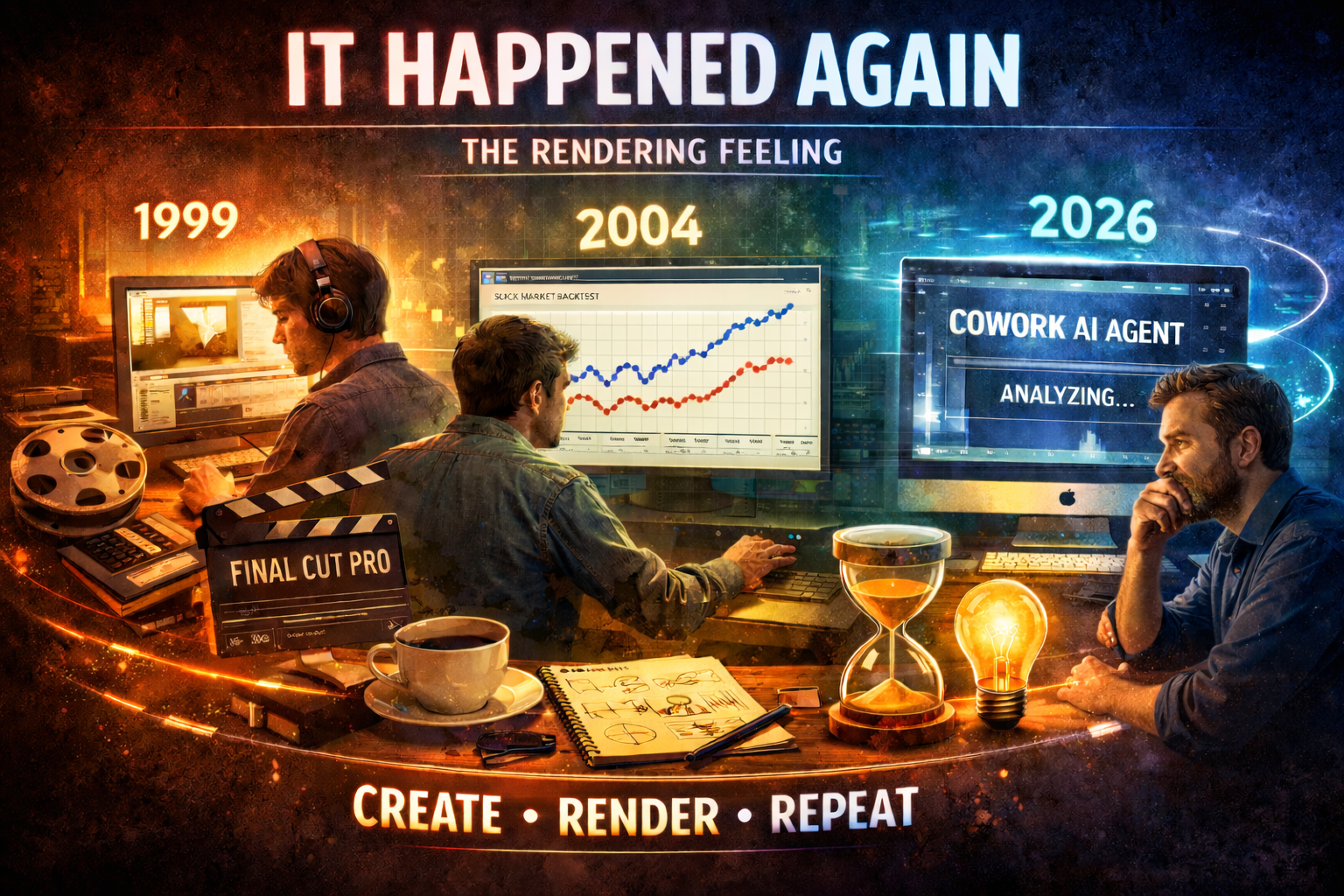
The last time was ChatGPT in early 2023. Before that, it was discovering Market QA backtesting software in 2004. And before that, it was Final Cut Pro on a Mac in 1999.
Each time, the same thing happens. Your brain shifts its perception of time.
A quick note on what this blog is not about. It's not about whether AI is a bubble or which industries get disrupted. It's not about the social implications — loss of jobs, loss of meaning, and all the other risks that we are thinking and hearing about daily. Those are real and important conversations. But not this one.
This blog is just about a feeling. The feeling of using a new technology for the first time and watching the walls of what's possible move outward. And its about the fact that staying creative now matters more than ever.
The Rendering Feeling
In the 90's, I was editing movies analog style. Tape-to-tape. Linear, slow and painful. Then one day I came across a state of the art Final Cut Pro on a Mac and my mind was blown.
It just happened again with the release of Cowork by Anthropic a few weeks ago.
Anyone who has ever rendered a movie in Final Cut knows the feeling. You spend digital days instead of analog weeks piecing things together. You hit "render," and wait a few hours. The machine works. You anxiously await. You scribble ideas on paper. You eat a snack. Then it's done — you review the magic — the dopamine is strong — you go for more.
In mid 2000’s I came across MarketQA for backtesting factor strategies, and it felt the same. You design the model, programming away deep into night, run the simulation, wait for the output. Your mind is already imagining the next five ideas.
That artist’s loop — create, render, repeat — is the heartbeat of innovation. It's the rhythm I've been chasing my entire career. And Cowork just cranked it up to a level I didn't think was possible.
Two Zones
My day is split into two zones.
Zone 1: Cowork is running something. Zone 2: Cowork is idle.
Zone 1 feels euphoric. Zone 2 feels dangerously bland. Do I really have to wait in traffic or stand in line? I could have summarized every important podcast that came out in the last week in that time!
URL mappings for thousands of companies that took weeks? — Minutes.
Months of manual data extraction — Done.
Building a web dashboard with results from scratch? — 7 minutes.
Advanced econometrics dusting in your senior textbook? — PhD grade in minutes.
It reads files with millions of rows in seconds, understands the context, learns from mistakes, finds better ways to solve things when it gets stuck, reviews its work, and produces something that would have taken me months.
The investment process has become the innovation process.
The Bet That's Paying Off
Readers of this blog know that I've spent years encouraging divergent thinking over convergent thinking. The creative quant over the engineering quant. Innovation over process. A blank page and a pen over someone else’s research.
That bet is paying off.
The prompt window is the new blank page.
Because now you can pretty much ask a computer to do anything digitally. What cannot be automated (yet?) is the original idea. The research question. The creative moment that your body recognizes before your mind catches up.
The core human skill was always idea generation. People who spent decades sharpening their creative instincts — asking better questions, developing taste, cultivating the uncomfortable ideas — are the ones who will likely thrive now. The tools finally caught up to the vision.
Who knows, maybe soon humans won’t need to enter the creation loop at all. Can the machine create-render-repeat on its own without any human prompting, directing, connecting outputs to the real world? If that is possible, we are not there today.
Not Hype
In 2019, I wrote a blog called "AI and Alternative Data in Investing — Hype or Reality?". At the time, most quants preferred the term "Machine Learning" and the consensus was skeptical. Man Group's CIO said ML wasn't helpful for forecasting returns. Others warned about rabbit holes.
My view then: "First, one needs great research questions, and then the tools to help find the answers. If the order is reversed and the tools are driving the ideas, then the rabbit holes likely await."
That view hasn't changed. But what has changed is the power of the tools.
It clearly wasn't hype. It's obvious now.
Another Industrial Revolution — For Real This Time
In my 2021 blog on the very-long-run CAPE ratio, I showed a chart spanning two centuries of market valuations, overlaid with the great industrial revolutions. I labeled the current era as the beginning of a new one. At the time, it was more of a hypothesis.
It's no longer a hypothesis.
The steam engine compressed physical labor. Electricity compressed manufacturing. The internet compressed information. AI is compressing cognitive work — and Cowork is the moment when that compression became visceral. Not theoretical. Not a demo. Not a chatbot answering trivia. An agent, inside your computer, doing real work, at a pace that rewires your sense of what's possible.
Innovation has always been the engine of growth — in economies, in biology, in investing. The 2025 Nobel Prize in Economics confirmed what we've been writing about for years: sustained growth comes from innovation, not from inputs alone. Now the tools of innovation themselves are being innovated upon. That's a recursive loop with enormous implications.
Don't Go Mad
There is a catch: don't go mad.
The potential is so vast that it's disorienting. Every hour, I think of ten new things to build, test, analyze, or create. The temptation is to chase all of them. To launch everything at once. To confuse activity with progress.
But the fundamentals haven't changed. The best investors, the best researchers, the best creators — they've always known that alpha comes from focus, not from volume. From the quality of the question, not the quantity of the output. From knowing when to stop iterating and start believing.
So yes, the day is split again: co-work is ON and co-work OFF. Same as Final Cut Rendering in the 90's. Same as MarketQA Processing in 2004.
But this time feels different because the work is no longer limited to movies or backtests. It’s now our entire knowledge driven experience.
It’s disorienting to digest that we are “just” getting started.
Fittingly, I wrote this blog iteratively with Claude — the very AI this blog is about. I provided the ideas, structure, and edits. Claude researched my past blogs, learned my writing style, and helped draft and refine the text. I took about an hour of total editing time to make it “mine”. The image is from chatGPT, it made it based on this blog. Create, Render, Repeat.
Disclosure: Two Centuries Investments is a registered investment advisor. This material is for general information and reference purposes only and does not constitute tax, legal, or investment advice and is not intended as an offer to sell, or a solicitation to buy securities, services or investment products. All information has been obtained from sources believed to be reliable, but accuracy is not guaranteed, and reliance should not be placed on the information presented. This material may not be reproduced, copied, or transmitted, or any of the content disclosed to third parties, without the permission of Two Centuries Investments. Past performance is not a guarantee of future results.